Role Based Pricing for WooCommerce
Role-based WooCommerce pricing assigns different product rates to customers, wholesalers, affiliates and individual clients using fixed or percentage adjustments.
Instant access Original unmodified files Free future updates
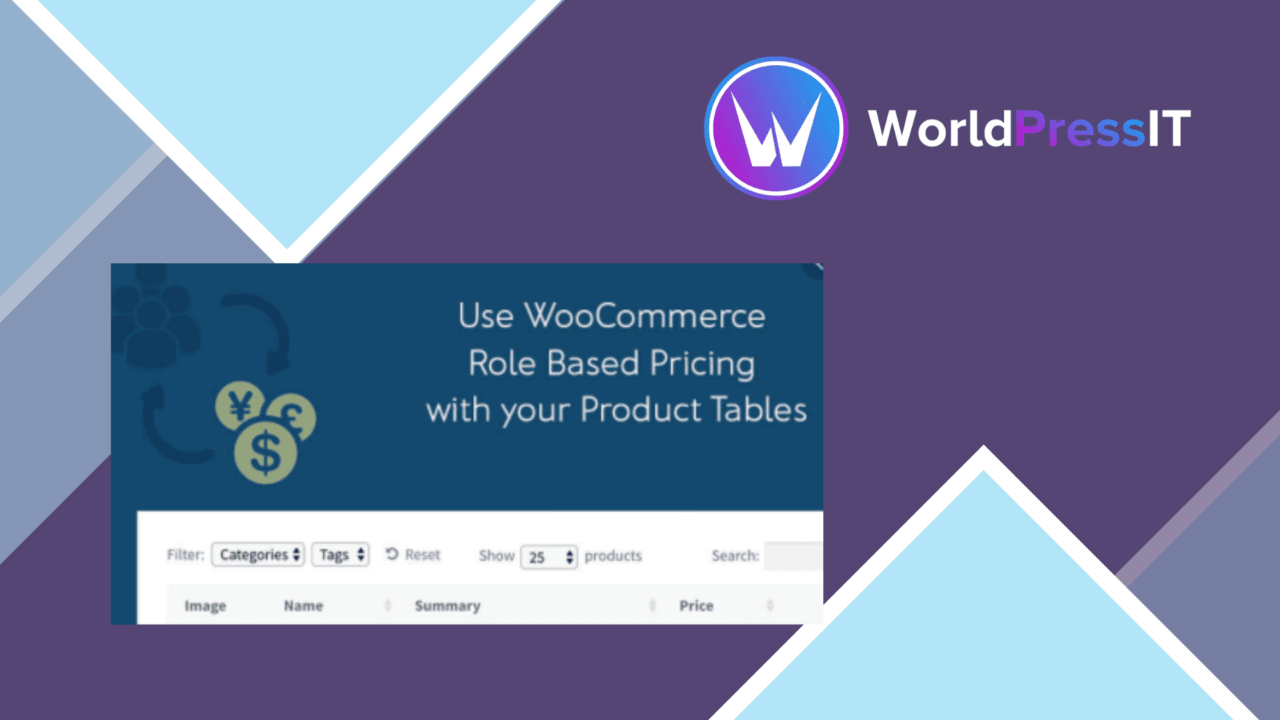
Role Based Pricing for WooCommerce changes the assumption that every shopper should see the same product price. It assigns pricing rules to user roles and individual clients, giving a store a way to separate customer, wholesale and affiliate rates without maintaining entirely separate product catalogues. Adjustments can use a set amount or a percentage, and the regular price remains visible to shoppers outside the selected audience.
Pricing by role
The plugin is built around targeted pricing rather than a single store-wide discount. A customer role can receive one rate, a wholesaler another, and an affiliate a separate adjustment. The same approach extends to named individual clients, which is useful for businesses that have negotiated terms with specific accounts. Discounts and markups are both supported, so the feature is not limited to promotional reductions.
This model suits stores serving several types of buyer from one WooCommerce installation. A retailer can keep public pricing for ordinary shoppers while presenting a different rate to an approved group. The important distinction is visibility: once a rule applies, the defined consumer or user role sees the modified price, while other visitors continue to see the regular price.
Product and category rules
Rules apply at two useful levels. Individual products support fine control for selected stock, while categories provide a broader way to establish a pricing policy across a related range. That combination avoids forcing every adjustment into the same scope. A store with a wholesale category can set a category-level rule, then handle a special product or client separately.
Vendor documentation also lists adjustments based on user behaviour and purchase history. That points to a more responsive pricing model than static role assignment alone, although the supplied information does not explain the available conditions or how those rules are prioritised. Treat that part as a feature to map carefully against the store’s customer data before building a large rule set.
Showing the right price
Pricing display is customisable on the front end, which matters when different shoppers need different explanations of the same product. The stated goal is to show the adjusted rate to the intended audience and preserve the normal rate for everyone else. The plugin is also described as responsive, so the pricing presentation is intended to remain usable across device sizes.
Reporting features are included for tracking pricing effectiveness and user engagement. That gives store owners a way to review how role-based pricing performs rather than treating each rule as permanent. The source material does not specify the reports, metrics or export options, so buyers should confirm that the reporting depth matches their decision-making process.
Where it falls short
The first trade-off is administrative complexity. Once prices vary by role, product, category and individual client, the store needs a clear naming and review system to prevent overlapping rules from becoming difficult to explain. The vendor copy does not describe rule precedence, conflict handling or bulk-edit tools, so larger catalogues deserve particular care.
The second limitation is the narrow pricing vocabulary described here: fixed or percentage adjustments. Those options cover common discounts and markups, but they do not establish support for quantity breaks, currency-specific pricing, minimum order thresholds or formula-based rates. Behaviour and purchase-history rules introduce another dependency: accurate customer data and consistent role assignment are essential to showing the intended price.
Who it suits
This plugin fits WooCommerce shops with distinct customer groups and a genuine need to keep their pricing inside one catalogue. Wholesale operations, affiliate-led stores and businesses with negotiated client rates are the clearest matches. Category-level rules help when a policy applies to a product range, while product-level and client-level controls handle exceptions.
It is less compelling for a simple retail shop with one public price, or for a business that needs an elaborate pricing engine beyond role-based fixed and percentage changes. For the right store, its value is direct: define who receives a different rate, choose the adjustment, and keep the standard price for everyone else.
The verdict
Download Role Based Pricing for WooCommerce and see for yourself
You get the full Role Based Pricing for WooCommerce release (v2.2.2), ready to install, plus every update that follows. One click and it is yours.
Download Role Based Pricing for WooCommerce v2.2.2- Instant download
- Original developer files
- Updated 9 Sep 2026
Related reviews
Browse all
Advanced Order Export For WooCommerce
Export WooCommerce orders and selected custom fields to CSV, Excel, XML or JSON, with filters and scheduled runs for rec…
YITH WooCommerce Questions and Answers Premium
Product-level questions and answers give WooCommerce shoppers clearer buying information, while moderation, notification…

CTX Feed Pro
WooCommerce product feeds in XML, CSV, or JSON, with templates, filters, scheduled updates and channel integrations for…